



AGATH - a flexible flamelet library in modern Fortran
AGATH is a flamelet solver library similar to other known libraries such as CHEMKIN or Cantera. The code has been developed at EM2C since 2012. The code has been validated and used in multiple theses to obtain laminar flame solutions, compute evaporation or implement detailed thermodynamics and transport properties in a CFD solver along with chemistry. A non-exhaustive list of available solvers is homogeneous reactors, detonation, steady and unsteady counterflow flames in spatial or mixture fraction space, and premixed flames.
AGATH contains zero- and one-dimensional solvers and evaluates thermodynamic and transport properties and chemical sources terms appearing in the Navier Stokes equations, implementing various kinetics and transport descriptions. It focuses on flexibility for the developer and user side to compute canonical flame configurations with different modeling approaches seamlessly. For example, thermodynamics can be described with constant properties, NASA polynomials, AVBP thermodynamics, or tabulated chemistry. The other solvers available with the AGATH library rely on similar flexibility for the kinetics and transport description.
The library relies on modern Fortran and the object-oriented paradigm. For example, the solver flexibility allows easy manipulation of objects in uncertainty quantification studies. The ability to numerically solve one-dimensional sets of partial differential equations involving convection, diffusion, and reaction is also used to provide wall models where the Thin Boundary Layer Equations are solved.
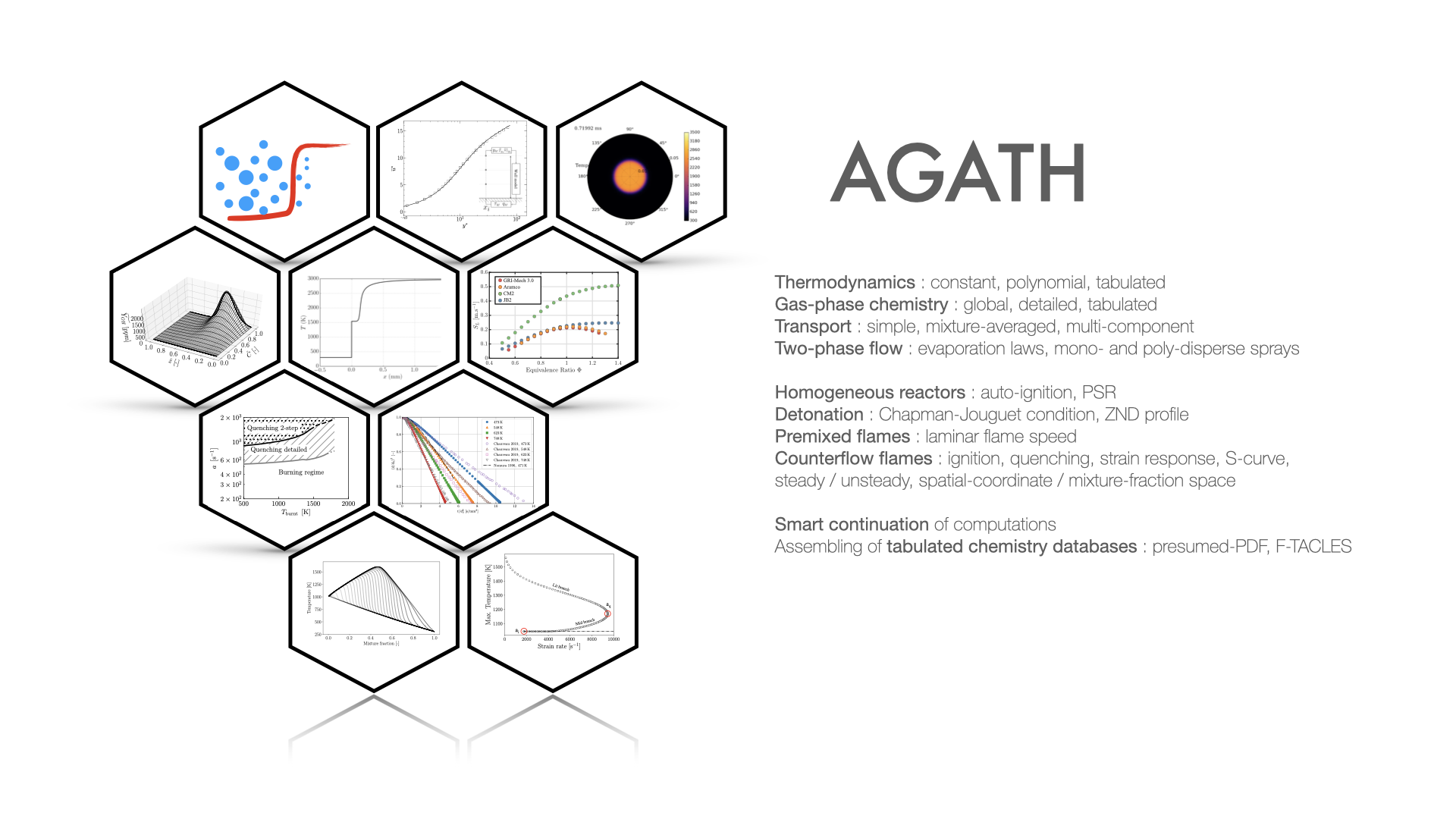 The source code and wiki can be found at https://gitlab-research.centralesupelec.fr/commcomb/agath for authorized users.
- T. Lancien, “Étude numérique de l'allumage diphasique de foyers annulaires multi-brûleurs”, Theses, Université Paris-Saclay (Oct. 2018).
- N. Dumont, “Méthodes numériques et modèle réduit de chimie tabulée pour la propagation d'incertitudes de cinétique chimique”, Theses, Université Paris Saclay (COmUE) (Jul. 2019).
- L. Palluotto, “Quasi-Monte Carlo computation of radiative heat transfer in coupled Large Eddy Simulation of a swirled premixed flame”, Theses, Université Paris-Saclay ; Université libre de Bruxelles (1970-....) (Jul. 2019).
- A. Degenève, “Stabilization, structure and thermal behavior of oxy-flames with a variable swirl level”, Theses, Université Paris-Saclay (Oct. 2020).
- M. Gelain, “Aerothermal characterisation of a surface heat exchanger implemented in a turbofan by-pass duct”, Theses, Université Paris-Saclay (Nov. 2021).
- K. Torres, “Numerical simulation and thermal radiation analysis in sooted flames: impact of radiative properties description”, Theses, Université Paris-Saclay (Jul. 2021).
- L. Lecointre, “Hydrogen flame acceleration in non-uniform mixtures”, Theses, Université Paris-Saclay (Jun. 2022).
- K. Töpperwien, “Numerical analysis of light-round ignition in annular spray-flame combustors with realistic thermal wall conditions”, Theses, Université Paris-Saclay (Jun. 2022).
- K. Töpperwien, F. Collin-Bastiani, E. Riber, B. Cuenot, G. Vignat, K. Prieur, D. Durox, S. Candel, R. Vicquelin, "Large-eddy simulation of flame dynamics during the ignition of a swirling injector unit and comparison with experiments", Journal of Engineering for Gas Turbines and Power 143(2) (2/11/2021 2021).
- G. Vignat, D. Durox, A. Renaud, T. Lancien, R. Vicquelin, S. Candel, "Investigation of transient pvc dynamics in a strongly swirled spray flame using high speed planar laser imaging of sno2 microparticles", Combustion and Flame 225 (2021) 305--319.
- K. Töpperwien, R. Vicquelin, "Numerical analysis of relight in an annular spray-flame combustor with preheated walls", Proceedings of the Combustion Institute (2022).
- J. Ben Zenou, R. Vicquelin, "Acceleration of premixed H2-Air-Steam flames when accounting for thermal radiation", Combustion and Flame 258 (2023).
- J. Ben Zenou, R. Vicquelin, "Coupling regimes of premixed laminar flames with thermal radiation absorption in fresh gases. Application to H2O-/CO2-diluted mixtures", Combustion and Flame 271 (2025).